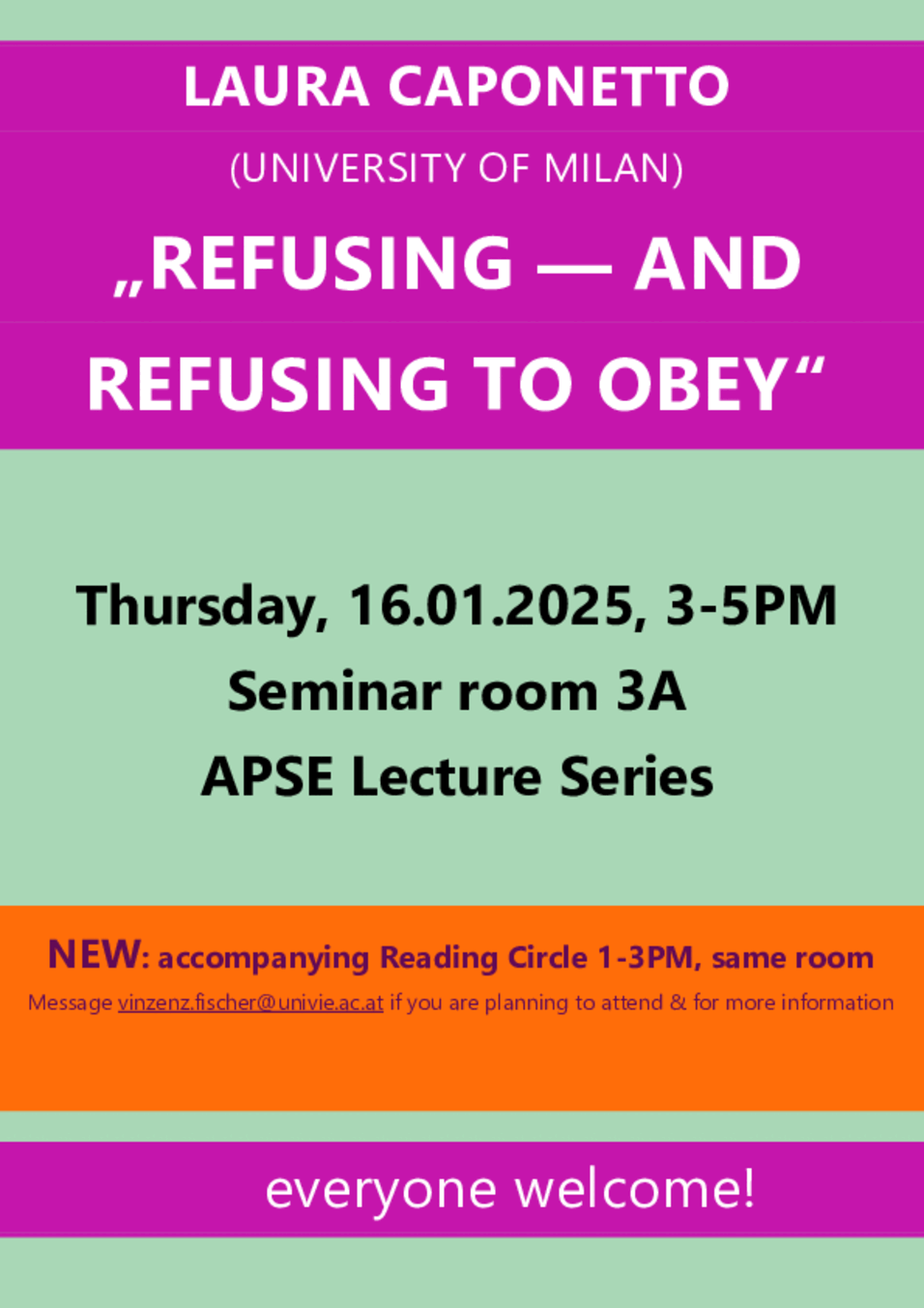
NEW: accompanying Reading Cycle
in addition to the APSE talk by Laura Caponetto (University of Milan) "Refusing - and refusing to obey" we want to kindly invite you to our accompanying Reading Circle. It will take place right before the talk in the same room, so:
Thursday, 16.01.2025, 1-3 pm, HS 3A
We will focus our discussion on the text: Caponetto, L. (2023) "The pragmatic structure of refusal" Synthese 201:187.
As introduction to the field, we suggest: Green, M. (2020) . Speech acts. In E. N. Zalta (Ed.), The Stanford encyclopedia of philosophy (Fall 2021 Edition). plato.stanford.edu/archives/fall2021/entries/speech-acts/
For further reading regarding the topic:
Caponetto, L. (2017). On silencing, authority, and the act of refusal. Rivista di Estetica, 64, 35–52.
Langton, R. (2018b). Blocking as counter-speech. In D. Fogal, D.W. Harris, & M. Moss (Eds.), New work on speech acts (pp. 144–164). Oxford University Press.
Sbisà, M. (2019). Assertion among the speech acts. In S. C. Goldberg (Ed.), The Oxford handbook of assertion (pp. 158–178). Oxford University Press.
Please send a quick message to vinzenz.fischer@univie.ac.at if you are planning to attend!
Feel free to bring your lunch!
Abstract
We can do several different things with the word ‘No’. We can turn down an offer, decline an invitation, deny permission. We can engage in civil disobedience. In this talk, I aim to map these varieties and unpack the normative profile of refusal. I argue that refusal constitutes an illocutionary family comprising acts which have different felicity conditions but share the definitional normative function of preventing certain obligations from being created or waived. I begin by singling out what I take to be the paradigmatic case of refusal. I then broaden the picture a little, to consider speech acts that share ‘family resemblances’ with this paradigmatic case. And then I broaden it further, to look at speech acts that populate the ‘illocutionary neighborhood’, including ‘refusal to obey’.
The talk expands upon my previous work on the topic (Caponetto 2023). While that work was primarily concerned with ‘upstream norms’ for refusing (i.e. the conditions under which refusal succeeds), I here focus on its ‘downstream norms’ – on the changes refusal effects on the normative landscape.